Don Quixote Sees Through the Forged Sequel
Don QuixoteDon Quixote Sees Through the Forged Sequel is the episode in which Don Quixote encounters a rival account of his adventures and answers it by scrutinizing its claims and changing his route. The book’s errors are not merely literary defects to him: they misrepresent his constancy and Sancho Panza’s identity. By refusing to follow the false sequel’s itinerary, he makes the dispute over which Don Quixote is authentic part of the action itself.
Discovery at the inn
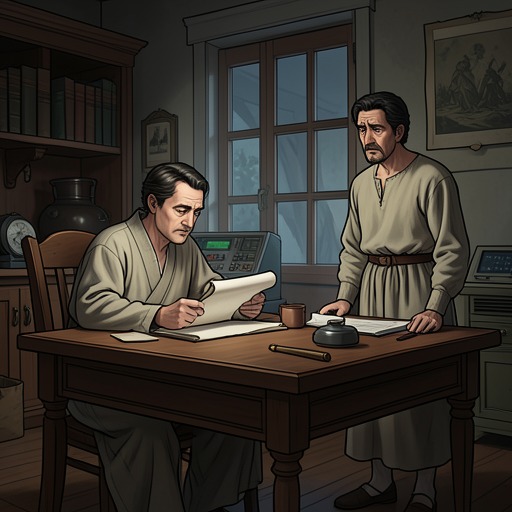
At supper, Don Quixote sits down in his room with the stew brought in by the landlord. A thin partition separates his room from the next, where he overhears Don Juan proposing that he and Don Jeronimo read another chapter of The Apocryphal Second Part of Don Quixote. Their conversation immediately marks the sequel as a contested object. Don Jeronimo dismisses it as absurd beside the First Part, while Don Juan allows that even a poor book may contain something worthwhile. Their disagreement gives Don Quixote time to listen before he reveals that he is present and hearing them discuss him.
One particular claim provokes his reply: Don Juan says the sequel represents Don Quixote as cured of his love for Dulcinea del Toboso. Don Quixote rises and declares his constancy rather than letting the account define him. His response turns a conversation in the neighboring room into a confrontation between the living character and the printed version being read aloud. Sancho supports his master’s claim, identifying the speaker as Don Quixote himself and insisting that he will stand by what he says.
The book and its errors
Two gentlemen enter, and one embraces Don Quixote, recognizes him as the genuine Don Quixote of La Mancha, and presents the book his companion has brought. Don Quixote looks through it but does not undertake a full reading. He identifies three grounds for censuring its author: wording in the preface, an Aragonese manner of writing that sometimes omits articles, and, above all, a departure from the truth on a major point of the story. His scrutiny moves from style to the question of whether the account can be trusted.
The clearest factual test concerns Sancho’s household. The sequel gives Sancho’s wife the name Mari Gutierrez; Don Quixote corrects it to Teresa Panza. He treats this not as a harmless slip but as evidence that the writer may be unreliable elsewhere. Sancho joins the criticism, objecting that an author who misnames his wife may also have misrepresented him. Their response makes domestic detail a measure of narrative authority: the false account has failed to recognize people whose lives are familiar to the pair themselves.
The episode also distinguishes the figures in the rival book from the characters in the account attributed to Cide Hamete Benengeli. Sancho describes the authentic pair as a valiant, wise, and faithful Don Quixote, alongside a simple and humorous Sancho who is neither glutton nor drunkard. The gentlemen accept the distinction and suggest that only the original historian should write about Don Quixote. Don Quixote, however, does not demand that nobody else portray him; he objects to being abused. The exchange makes the question more complicated than a simple claim that no other account may exist: the decisive issue is whether it treats its subject truthfully.
Refusal and change of route
Don Juan asks Don Quixote to read more of the book, but he refuses. He considers it read from the little he has seen and calls it silly; he also says he does not want its author to imagine that he has read it. His refusal closes off the possibility of giving the rival text further authority through extended attention. The gentlemen nevertheless provide information about its plot: it sends a Don Quixote to Saragossa to take part in the city’s annual harness jousts, and describes his performance at a tilting at the ring as poor in invention, mottoes, and costume.
That itinerary changes what Don Quixote does next. Rather than go to Saragossa and risk appearing to confirm the sequel’s account, he decides to avoid the city. He states that this will expose the new historian’s falsehood and show that he is not the Don Quixote described in that book. Don Jeronimo points out that Barcelona offers other jousts at which Don Quixote can display his prowess. Don Quixote agrees, and the conversation ends with his intention to go there. The next morning, he leaves the inn after first finding the most direct road to Barcelona that avoids Saragossa.
Identity, authorship, and consequence
The episode makes a printed fiction an immediate cause of action. Don Quixote’s response depends on details: his love for Dulcinea del Toboso, Sancho’s correct name for his wife, and the route the rival book assigns him. These details allow the characters to contest the sequel from within the story, while the reader sees them judge a published account against the identity established in the First Part. The episode therefore turns the difference between a character and a version of that character into a practical question: which account will determine what happens next?
The result is not simply a declaration that the rival book is false. Don Quixote alters his journey so that his actions will contradict its report. Avoiding Saragossa becomes both a response to the book and a public test of its reliability, while the turn toward Barcelona carries the narrative forward. The scene’s irony rests on the fact that a book he has barely inspected can still redirect his travels: he refuses to recognize its authority, yet takes its prediction seriously enough to evade it. In this way, the dispute over authorship enters the plot as a choice of road, and the character’s defense of his identity becomes inseparable from the story’s next movement.